
It occurred to me late last night, while I was supposed to be sleeping, that I don’t need a Word expert at all. All I need to do is go back to the printer that did the letterhead in Word format for us in the first place, and have him do it in two pieces, a header and a footer! No problem. After that, it turns out we have people on staff that already know how to assemble the Word and Excel pages in Adobe so we can print the entire report in one finished piece! In the meantime the suggestions and kind offers are flooding in, but now we’ve got this one figured out. I’ll try to think up something more challenging to be confused about next. Thanks all.
I took one for the team
We issue audit reports that are a combination of pages printed from Microsoft Word for the narrative part, Excel for the actual financial statements, and with one page printed on letterhead. So after printing, there is assembly and proofing to make sure everything gets put together in the right order. After all of that, we turn around and scan the report back into digital form. For years, I’ve been wanting to streamline the process by combining these individual parts digitally before printing instead of manually afterward, but the skills required are beyond our basic word processing ability at Taylor, Roth and Company. I thought maybe over time we’d accidentally hire the skills to figure this out ourselves, but we keep hiring accountants and not word processing experts, so that hasn’t happened yet. I decided to handle this myself. There are two parts to the challenge: first, somehow combine Word and Excel pages into a single seamless document and second, insert the letterhead page digitally right into the document instead of having to separately print one page on letterhead. I decided to attack the second challenge first; one page of letterhead inserted digitally into a document. How hard could it be? We even have a digital copy of our letterhead already. I pressed F1 in Word for help. I searched for “letterhead”. I read the results. I couldn’t understand the options. I Googled “how to insert letterhead into Microsoft Word documents.” Still too hard. I don’t want to spend the time learning to be an expert in word processing so I’ll know how to do it, I just want it done. I Googled “Help with Microsoft Word”. I’ll just pay someone who already knows how to do it to do it for me. The point-and-pay method. $79. A bargain. It didn’t turn out to be quite that easy. It took three separate tech support sessions spread out over three days, with my computer held hostage for hours altogether while the tech worked on my screen instead of his own. But finally, we have it; the result. And the result is: I fired them. Most of the work was by live chat, but when we talked on the phone I couldn’t understand them. When I explained what I wanted, they couldn’t understand me. What they produced was wrong and I couldn’t get them to understand why. I gave up. I meant to fall on the tech support grenade for the good of the team, but my effort fell short. I still think this is a 5 minute job for someone who knows what they’re doing; I just haven’t found that person yet. Once we figure that out, we’ll move on to the harder question about combining dissimilar files into a single document.
Friday the thirteenth
I always want to know when it is. This month it came on a Wednesday. Happy Birthday Becky; our Friday the thirteenth baby. It’s a good day.
Computers, dogs, drugs
We’re back at Sandpipers.
Water towers
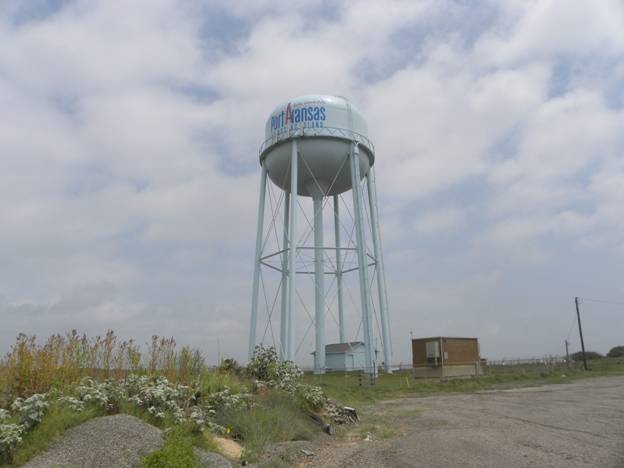 We see them in every small town; sometimes more than one per town. Port Aransas has two.
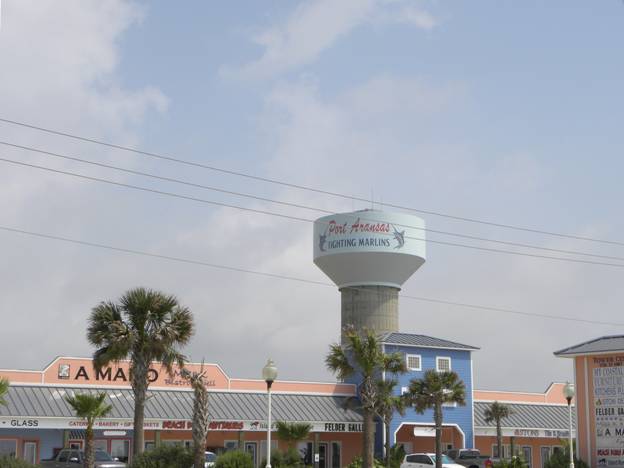 They’re probably in every big town too, but they’re really conspicuous in small towns on flat land, like the Midwest, and South Texas. Ever wonder what they’re for? Are they like those standpipes for irrigation systems that took me so long to figure out; giant burp holes to let out sudden excess pressure? Are they storage devices randomly built in the sky? There are so many shapes and sizes; are they doing different things? I had to look it up. Water towers provide constant pressure for the water supply. Put some water up high and gravity wants to bring it back down. Tie that into your water system, and suddenly it’s pressurized. The higher you put the water, the more pressure it provides. You can make the tower look like anything you want. They all do the same thing; provide pressure. So you put enough water up in a tower to provide about one day’s supply for the community. The minimum height to supply enough pressure from gravity is about 80 feet. That will give you maybe 35psi. The more pressure you want in your water system, the higher you build the tower. Many municipal water systems want to maintain 50 to 100 psi, so their water towers are much higher. With a water tower, not only have you established the right amount of pressure, but you only need to buy a pump big enough to handle the average daily usage for the town. Maybe a city averages using 500 gallons of water per minute over the course of 24 hours, but peak demand might be 2,000 gallons per minute. Using a tower with one day’s water in reserve means they only have to buy a 500 gallon per minute pump, not a 2,000 gallon per minute pump! It’s not a static system; it’s dynamic. Water from the tank gets used every day, then the tank gets filled back up at night. If your pump breaks, you’ve got a backlog of one day’s worth of water. You’ve got a day to fix the pump before anyone even knows it’s broken. And of course, this tower in the sky is the perfect place to promote your local high school team.