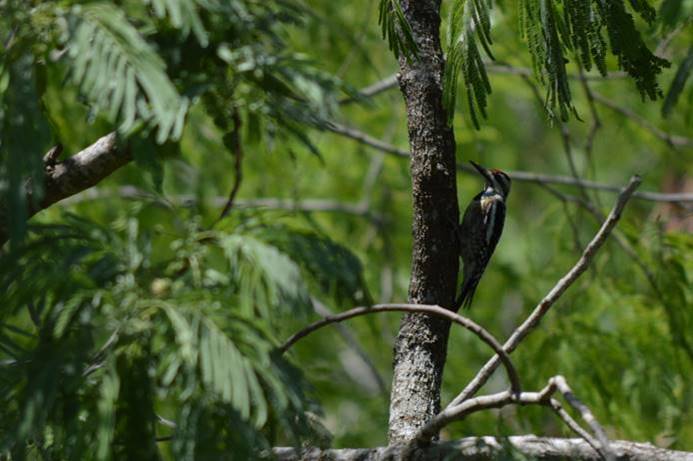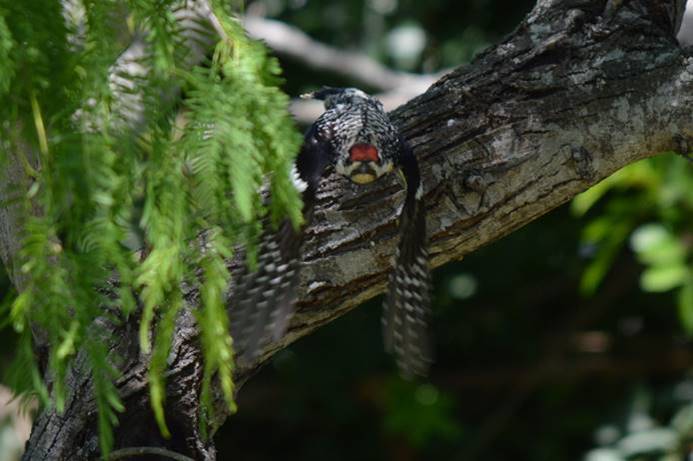


Whatever that is…
I can’t remember.
Whatever that is…
I can’t remember.
They roost in communal nests. Like this, in the town of Hidalgo, 22 miles from our house. Check out the big lump on the power pole on the right of the road.
The nest is made out of sticks they’ve gathered.
If you stop to look, with any luck, there will be parakeets standing around.
…that look like this.
Charming little guys.
Monk parakeets aren’t originally from here. They’re exotics from South America.
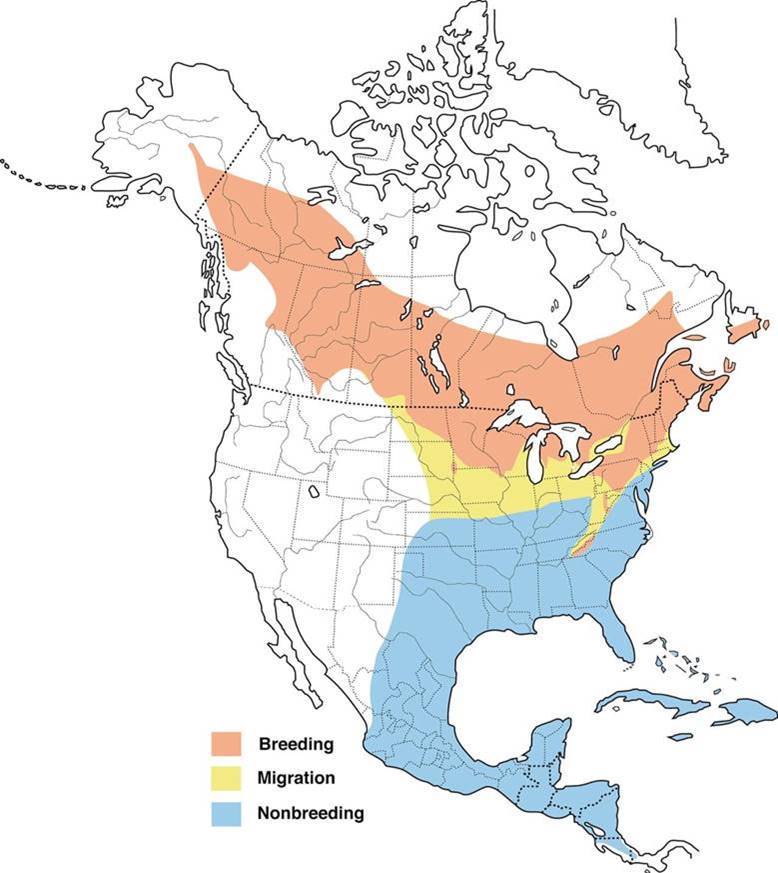
They’re established mostly in Florida, but we’ve got several colonies in Texas too, even though they don’t even show up on the map.
I’m not worried about what all the people in the health insurance industry will do anymore if they get put out of work by a single payer health care plan like medicare for all. They’ll all either go to work for the government running the new plan or wander off to do something else.
It’s not like entire industries haven’t been replaced in the past. All the mechanization and automation of manual labor that has been developed since the 1900s has displaced countless workers. Consider the spinning wheel, production lines, paint spray guns, bottling machines, and all the construction equipment replacing men with shovels. What about the entire industry built up around horses and buggies or wagons as transportation? The internal combustion engine put the horse and buggy industry out of business in a flash (maybe a 50 year flash, but yeah). Horses required so much infrastructure. Hay and grain fields. Stables. Farriers. Buggy and buggy whip makers. Teamsters. Even people who would dispose of manure and dead animals. All those industries and workers had to adapt.
It’s not to say we don’t have sympathy for displaced workers, we could protect men with shovels and outlaw bulldozers and save jobs, but refusing to use a productive piece of equipment like a bulldozer wouldn’t make any sense. As each industry goes away, the next generation of workers has to aspire to the next generation of jobs, not the jobs that used to be. Life is a little harder for the people caught in the middle, the ones working in the industry that dwindles. Some will adapt. Some won’t.
Uh-oh. I just got back to my original question, what to do with the people displaced by improvements in processes. I think it comes down to the fact that capitalism can be cruel. I like to think that we could have compassionate capitalism that would care about people left behind, but I don’t think compassion is written anywhere in the rules for capitalism. There can be government retraining programs for people displaced, but that’s not unfettered capitalism, that’s the government trying to protect us from capitalism. When you look at the income and wealth disparity in this country that capitalism has produced, it makes me think that government isn’t doing enough.
Okay. So I started out concerned about displaced workers in disrupted industries and ended up dissatisfied with capitalism and railing about a lapse of government. So what. Remember, I’m just saying what the voices in Judy’s head tell me to say.
I’m a great fan of spaced repetition learning. I was exposed to the concept early in my college career and I’m sure it helped my grade point average. The results of my Spanish language effort suggest that there might be limits to the effectiveness of spaced repetition though. It may not work as well for older people as it does for younger people.
I studied at least some Spanish every day for a year. (I’m sure I missed a few days in June, but otherwise I was diligent.) I used Rosetta Stone and Babbel. They both employ spaced repetition and review. I thought by the end of a year I might be something close to conversational; very basic simple conversation.
The result is that I know a few words. I can figure out most billboards that are only in Spanish (Spanish only billboards are not uncommon here in the Valley). A lot of words look familiar even if I can’t recognize what they mean. I recognize some simple phrases. When it comes to constructing sentences from scratch though, I’m not really there. To test my understanding of spoken language, when I find myself in a situation where people are speaking Spanish around me, I just sit and listen, let it all in, and see if I understand what they are talking about. Generally, I don’t. (I wonder if any of that is due to Tex-Mex. That’s what’s spoken here. It sounds like Spanish to me, but I don’t know how significant any differences between Tex-Mex and Latin American Spanish are.)
So here I am after a year of less-than-intense effort, but a consistent effort nonetheless. I didn’t get to where I had hoped I would be. I would like to know more Spanish than I know now, but after an entire year, I think I’ve had enough of devoting time to do Spanish every single night.
Not *that* Henry and Annie. Not our Henry and Annie. Judy has been exploring her family tree, which is getting easier to do with the internet. She just found out that the great grandparents on her father’s side, her dad’s grandparents, the ones she knew as a child as Grandma and Grandpa, were named Henry and Annie. Henry and Annie Williams in Galloway Missouri. Not far removed from the McCoy branch of the family. The grandmother in Missouri who flung chickens around in a circle over her head when it was time to cook one for supper, and her granddad who had a plow-horse named Jude, were named Annie and Henry.