I love this graphic


It’s an animation from the American Museum of Natural History showing the spread of anatomically modern man, Homo Sapiens, starting about 100,000 years ago. 


https://www.youtube.com/watch?v=PUwmA3Q0_OE&t=149s


Northward migration out of Africa wasn’t stopped by the equatorial jungles, but it was interrupted by the Saharan Desert.  When we/they migrated out of Africa, they had to go out the top right into the Middle East; the Fertile Crescent.  Then westward movement in Europe paused at what are now France and Spain until about 30,000 years ago.  That area had already been occupied for 300,000 years by Neanderthal Man, the result of an earlier migration of their ancestor out of Africa.  It may have been intimidating for modern man to encounter another species of humans already well-established there.  I wish there were enough evidence we could track earlier migrations like this one.  By the time Homo Sapiens migrated out of Africa there were already several other species of human living across Eurasia .  The family tree isn’t simple and linear.  There were several different species of humans all living at the same time.


The migration then flows northeast across Asia.  There must be geographical pattens of least resistance there to govern that flow.  Then it stalls at the Bering Strait.  Once the climatic conditions are right for that crossing, the entire western edge of the Americas are populated almost instantly on a timescale like this.  It took a lot longer for humans to migrate east across North and South America.  They were probably hindered by the barriers of the Rocky Mountains, southern deserts, and the Andes.  North America was slowly settled from west to east, then the Europeans arrived and quickly worked their way back from east to west.


Before the arrival of the Europeans in the Americas, we can see the Incas on the western slope of South America (Peru), the Aztec in Mesoamerica (Southern Mexico) and the Maya on the Yucatan Peninsula. 


A band of population growth happened all across Eurasia in the middle ages.  Relatively unimpeded by physical barriers, the great civilizations were able to exchange information and build on each other’s accomplishments when they weren’t killing and conquering each other.


The human migration made it to Australia 50,000 years ago, but that continent never achieved significant population until Europeans arrived.  The aboriginal people stayed hunter/gatherers and remained dispersed.  It’s the efficiency of farming that allowed for dense populations.  As crowded as it can seem in the U.S. at times, we’ve got nothing like the population density of India and China though.


What I describe may not be an exact rendering of what happened, I wasn’t actually there, it’s just what this looks like to me…

 

Physics Talk 5:30 Aspen Time Tonight


Tonight’s physics lecture.  Dark Matter.


Judy and I won’t be able to attend and explain it to you afterwards because we’re signed up for a lecture on bird language from Mitchell Lake Audubon Center in San Antonio at the same time.  Maybe you can attend the physics lecture on dark matter and explain it to us!


From: Aspen Center for Physics <patty@aspenphys.org>
Sent: Thursday, July 9, 2020 7:01 AM
To: Steve Taylor <steve@taylorroth.com>
Subject: Physics Talk 5:30 Aspen Time Tonight


2020 Heinz R. Pagels Physics Lectures

Please join us LIVE ONLINE TONIGHT

5:30 Aspen time (11:30 UTC) followed by an interactive Q&A


Lisa Randall

Harvard University


Darkly Charged Dark Matter


Dark matter by its very nature is elusive. Despite the abundant evidence for its existence, its nature remains a mystery. The challenge to theorists is to imagine the many ways in which it can hide in order to anticipate ways in which it might be discovered. In this talk, I discuss dark matter and how we might hope to find it – even if its interactions with our matter are limited to gravitational. I’ll even discuss some more speculative possibilities for how dark matter could have impacted evolution on Earth.


Professor Lisa Randall studies theoretical particle physics and cosmology at Harvard University. Her research connects theoretical insights to puzzles in our current understanding of the properties and interactions of matter. She has developed and studied a wide variety of models to address these questions, the most prominent involving extra dimensions of space. Her work has involved improving our under-standing of the Standard Model of particle physics, supersymmetry, baryogenesis, cosmological inflation, and dark matter. Randall’s research also explores ways to experimentally test and verify ideas and her current research focuses in large part on the Large Hadron Collider and dark matter searches and models.


Randall has also had a public presence through her writing, lectures, and radio and TV appearances. Randall’s books, Warped Passages: Unraveling the Mysteries of the Universe’s Hidden Dimensions and Knocking on Heaven’s Door: How Physics and Scientific Thinking Illuminate the Universe and the Modern World were both on the New York Times’ list of 100 Notable Books of the Year. Higgs Discovery: The Power of Empty Space was released as a Kindle Single in the summer of 2012 as an update with recent particle physics developments. Her most recent book, Dark Matter and the Dinosaurs, was on the NYT bestseller list and elaborates on some of the topics discussed in today’s lecture.

For more about Professsor Randall’s research, see https://www.physics.harvard.edu/people/facpages/randall


Introducer and Co-host: Csaba Csaki, Cornell University


Join us next Thursday for “The Evolutionary ‘Design’ of Protein Machines”

with Rama Ranganathan, University of Chicago


Aspen Center for Physics | 970-925-2585 | patty@aspenphys.org


Connect with us


Talks will be recorded and posted on our YouTube channel, AspenPhysics


Aspen Center for Physics | 700 West Gillespie St., Aspen, CO 81611


We grew up with cousins


My Dad and his two brothers all had kids.  There were two more kids from Mom’s brother.  We all got together often.  Each of us kids had cousins of comparable ages.  It was good to grow up with cousins.


As adults we all scattered but most of us have stayed in touch.  Now, after all these years, we discover two more cousins some of us didn’t even know we had!  After we were all grown up and gone, one of Dad’s brothers divorced, remarried, and had two more kids.  What a surprise a few weeks ago when word filtered back to us through our niece Christy that she had been contacted by someone in Florida that had found a DNA match with her.  With that, we now know we have two more cousins, Tania and Mark.  They are much younger than us; more like contemporaries of our children, but they are our first cousins and our kids’ second cousins.


Fun for us; we have two more cousins.  More dramatic than that for Tania and Mark.  They grew up vaguely aware that there were other family members out there but not knowing much about who and where they might be.  Growing up with just each other, no other family, suddenly they’re in touch with twenty or so newly found family members!  Even better for them, some of this pile of people are even more closely related than cousins, some are half-brothers and sisters.  We’re all talking on the phone and chatting by text and email; making plans to get together whenever it makes sense for any of us to travel again.


What a cool surprise for everybody.


What the


I’ve got this one source for tracking the Coronavirus.  I’ve been using it all year.


https://www.youtube.com/watch?v=NMre6IAAAiU


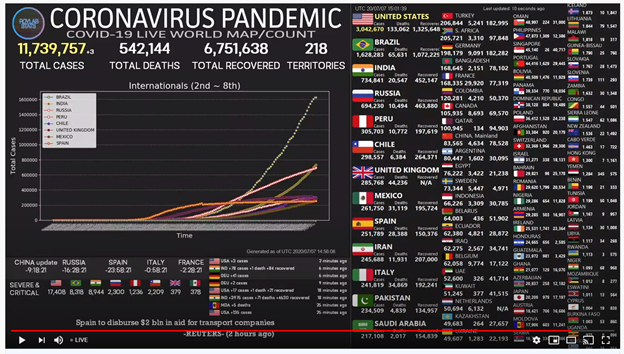
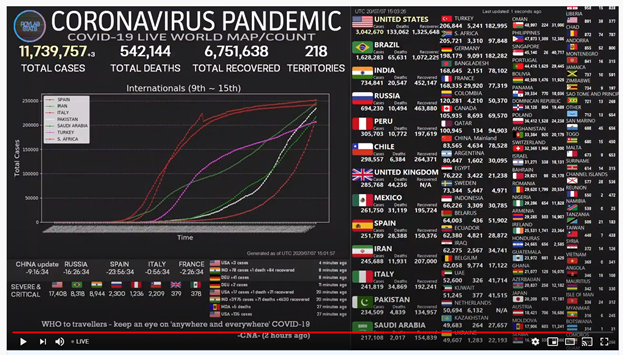
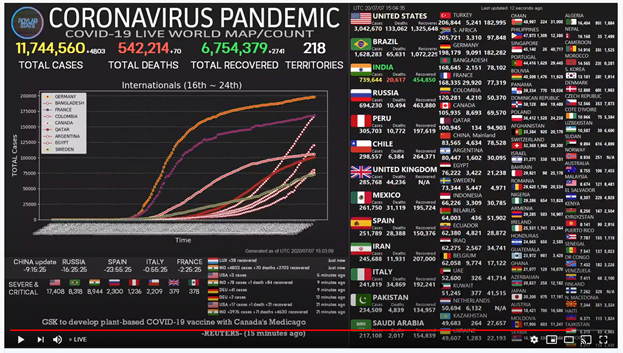
While you’re on that site, graphics scroll past.  I pick out the one that shows total infections for the U.S.  It can be a little tedious to catch, but if I collect it every time I visit, it gives me a consistent perspective.  This site used to show the highest eight countries on the first chart, then all the remaining most-infected countries on the following charts.  After a while, the U.S. headed so far off on its own scale, we were losing the detail for the other countries, so they devoted the entire first chart to the U.S., then showed all the other countries on different charts with different scales.  The ones for all the other countries look like this:


2 – 8.

Brazil is the star of the show on this page.


9 – 15.


16 – 24.


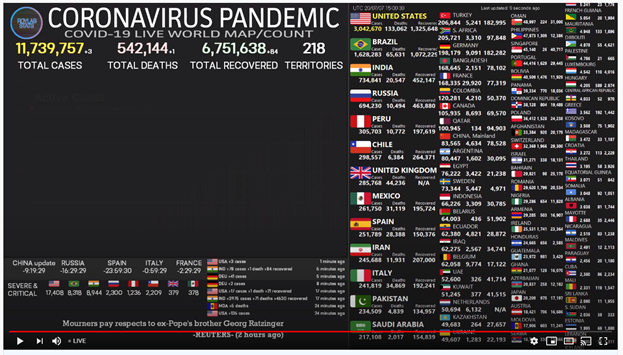
These charts show the 24 countries with the highest number of Coronavirus cases, except almost every time I look now, the chart for the U.S. is blank, like this.


At first, I thought I might have just caught the site loading data so it showed nothing, but that’s not it; it happens way too often for the U.S. screen, and never happens to any other pages.  I can still find the U.S. chart to copy once in a while, but it is getting much harder to catch.  I’m not normally one to wander down the conspiracy path, but this is quite the coincidence; the one chart we can’t see is the one that best illustrates our condition.  It seems almost as if someone doesn’t want us seeing that data…


Kid/Chimp Experiment


Observational learning in chimpanzees and children.  I watched a program about this years ago and it’s still in my head.  I thought it was going to be about whether a kid or a chimp would be better at the challenge.  There was a black box.  They taught both the chimp and the kids a sequence of pulling levers and sliding switches to get a reward out of the black box.  Both the kids and the chimp got proficient.


The kicker came when they unveiled the black box and it was made of see-through plexiglass.  They ran the experiment again.  It became obvious when the box was transparent that every one of the steps except the last didn’t really do anything.  All the subject had to do was skip to the end and pull that last lever and get the reward.  The surprising thing was that the chimp figured that out right away and went straight for the reward, but the kids went on performing all the now obviously unnecessary steps.


To me, it seemed that the chimp was smarter in that situation than the kids, and that’s what they were trying to demonstrate, but the researchers concluded something entirely different.  The researchers showed that learning was so important to the kids that they would continue to do what they were taught, even if it didn’t make sense in that instance.  Humans are hard-wired to learn by imitation, even if later they figure out that what they learned doesn’t make immediate sense.  The chimp, on the other hand, didn’t value accumulated learning, and only performed tasks that were appropriate to the situation at hand.  The chimp discarded the learning as soon as it saw the learning wasn’t productive; and that’s a giant difference between chimps and humans.  Humans pass along accumulated knowledge for complex situations and that body of knowledge grows with each generation.  Chimps, not so much.  The quickest road there isn’t necessarily what gets you the farthest.