Here is a bird spotted sleeping on a branch at Paradise Pond. It is clearly a member of the Caprimulgidae Family; commonly knows as Goatsuckers, but it’s not immediately obvious which one of those it is.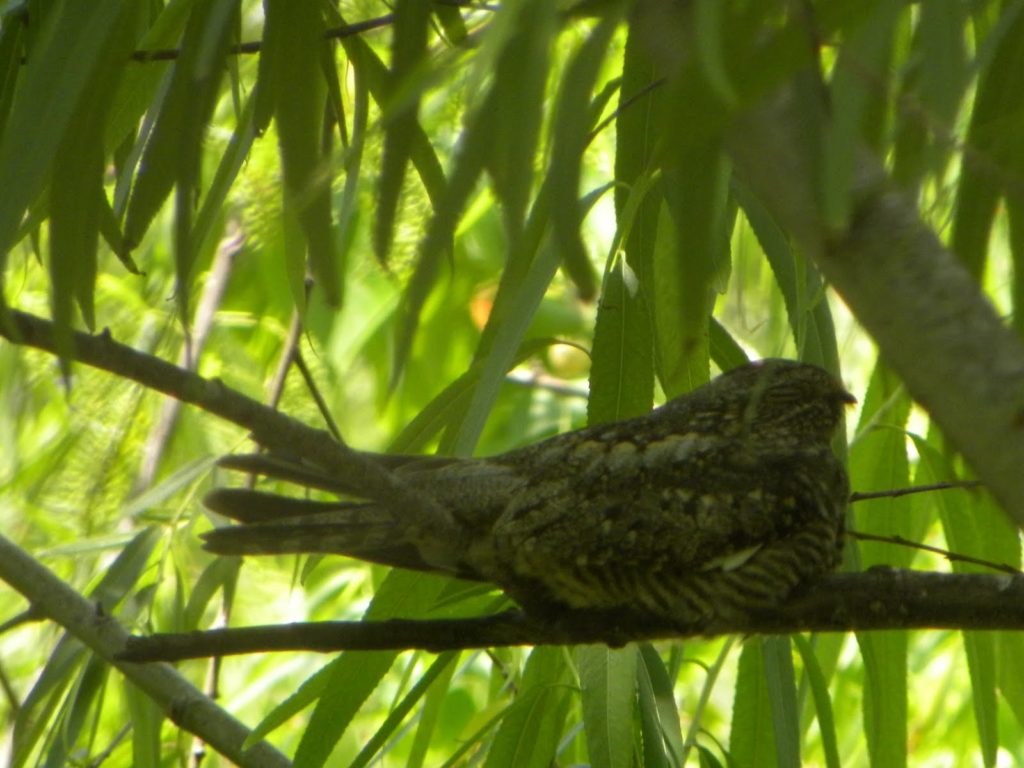
Goatsuckers are made up of two different kinds of birds, Nightjars and Nighthawks; seven different kinds of birds in all.
The North American Nightjar possibilities are Common Pauraque, Common Poorwill, Buff-collared Nightjar, and Whip-Poor-Will. Nighthawk possibilities are Common Nighthawk, Antillean Nighthawk, and Lesser Nighthawk. They all kind of look alike.
Our challenge was to figure out which resting Nightjar or Nighthawk this was. The first sort was easy. See the little white feathers just under the front of his folded wing? That makes it a Nighthawk, not a Nightjar. It doesn’t really mean anything; it’s just that you can always see those little white feathers on a Nighthawk, but not on a Nightjar.
The three nighthawks all pretty much look alike, so this is the harder part. It’s not likely to be an Antillean Nighthawk since that’s a Caribbean bird that shows up in way far South Florida in the summer, so we discounted that possibility. That left us with Common or Lesser Nighthawk. The Common and Lesser each show a white wing patch in flight, but the white wing patch is farther out on the wing for the lesser and a little farther in on the wing for the Common. That makes a difference in how the field mark looks at rest. In the bird above, you can see a noticeable white bar on the underside of the left primary wing feathers, close to his rump. It looks like a wide diagonal mark, which is a distinguishing field mark for a Common Nighthawk, but it is tricky to use, because placement matters, and the rear part of the bird is partially obscured by an extra branch there.
A structural key to use is the length of the folded up wings compared to the length of the tail. The primaries of a Common Nighthawk project past the tail feathers, and for the Lesser Nighthawk, the wingtips are even with the length of the tail. Color and exact placement of field marks are more likely to vary than the basic physiology of a bird, so for this bird, we choose form over field marks, and declare it to be a Lesser Nighthawk!